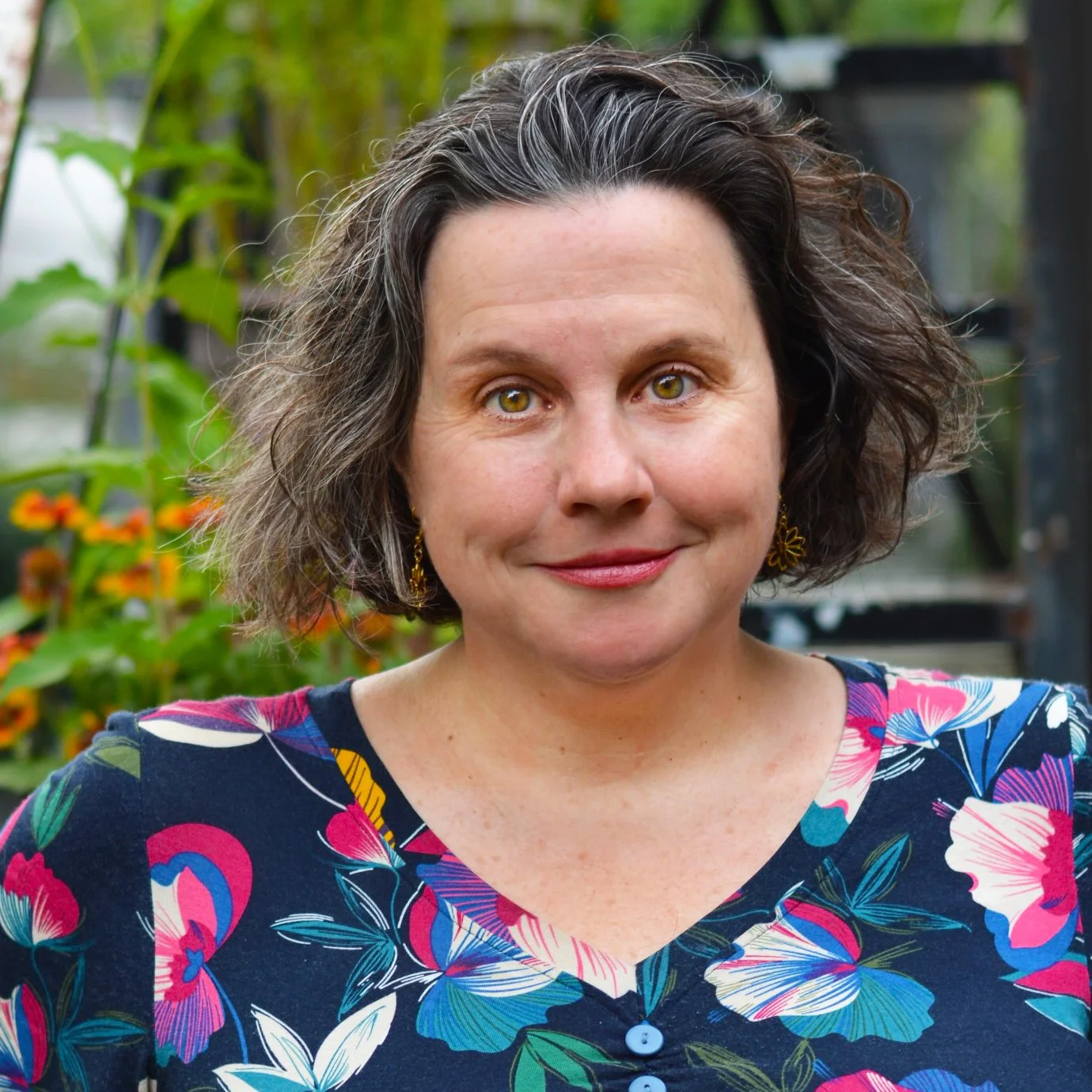
From the Spring 2026 edition of Gurls to the Front! A Q&A with Kerry Clare
I connected with this book in so many ways – it was so delightful to read! But first, I’m wondering if you could talk a bit about the shame, I would say, that women are made to feel about being single—the pressure we face to marry and have children and also the haunting fear of dying alone that leads us to make perhaps unsavoury choices?
What all of my novels have in common is protagonists who don’t feel shame and who don’t hate themselves (or their bodies or their choices). In this way, I regard myself as writer of fantasies, or at least this is my fantasy—that women can really be like this. In my own life, I have made conventional choices about marriage and motherhood, and I’ve been lucky in both, but I also made these choices so deliberately (and not because they were scripted for me) that I feel an affinity with any woman resolving to live her life on purpose, even if her choices are different from mine. And maybe especiallyif her choices are different from mine if those choices involve not hitching her destiny to that of a partner who will never ever be deserving of or properly appreciative of her goodness. The pressure to compromise is real and it’s ugly, and a society committed to telling all women that they’re never enough only compounds the problem.
But it’s complicated too because, while I could get up on my soapbox, I’m not going to deny that there’s a difference between commercial and literary fiction. The line is often blurry, hardly definitive, but there is a different kind of artistry between my novel and, say, The Safekeep, by Yael van der Wouden. But it is interesting that even in commercial fiction, male writers (I’m thinking of John Grisham or Harlan Coban) wouldn’t be regarded as lightweight in quite the same way that women writers are. So the gender element matters, for sure.
Finally, you dedicate this book to the people in your neighbourhood. I love the whole theme of the importance of community in the book, too. That’s something that feels very important now, as perhaps many of us are having nightmares of the impending robot takeover—the idea of interacting with real humans, face to face, and the importance of connecting on a smaller, community, neighbourhood level. Can you tell me a bit about your neighbourhood and what makes it special?
I love that one of the main inspirations for Clemence in this book is to right the wrong of a used bookstore that has a “Literature” section that contains only male authors and a “Women’s Fiction” section where all novels written by women are shelved. Would you like to elaborate on just how deeply this irks you? Also, maybe you have some thoughts on how books about relationships and the mundane are discounted as “women’s fiction” (unless, of course, they’re written by men, then they’re Very Important Books) and as not as relevant as the so-called “big” books about war and environmental collapse, etc. that win all the awards?
I subscribe to a “solutions journalism” newsletter called Fix the News (which has done wonders for my mental health even in these difficult times), and they had a fascinating conversation last fall on their podcast with journalist Bryan Walsh about how reading good news stories is regarded as less smart and sophisticated than news that is tragic and scary, even though it’s just as real. And I thought of that again recently when I saw a quote from Emily Henry pointing out the same phenomenon in fiction—a story with a tragic ending is more serious and important than one that ends with hope and optimism. So this is true even before we bring gender into the mix, and it’s really interesting to think about why this is.
I’ve actually been yelling about this on the internet for close to 20 years now, though less so lately because I’ve realized that I’m never actually going to get to the bottom of it and have the whole thing sorted out. Trying to categorise books, to categorise anything in our weird and ever-shifting world, is an impossible task. I’m trying to accept that instability and to understand how much these distinctions are all about taste anyway, more than anything definitive. People are going to like what they like. And what I like is books by women—they tend to be my favourite stories.
You have a podcast, Bookspo, where you talk to authors about the books that inspired the books they’ve written, so I’d like to ask you which books inspired this one. You mentioned Barbara Pym and Rebecca Solnit in your Acknowledgements, so maybe you could talk a bit more about those inspirations?
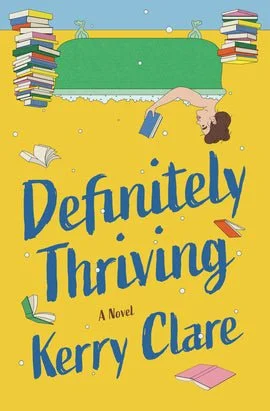
I love this question! I started writing this novel in 2021 during pandemic dread—I wanted to write something that would make me happy. I’d just read my friend Chantel Guertin’s rom-com Instamom, and I wanted to write something with similar humour and energy, and rom-coms were having a moment. But I seem incapable of writing anything that doesn’t veer off in the direction of a little bit weird—it’s a rom-com, but the love interest gets anxious diarrhea, the cat has one eye, and the plot hinges on a church jumble sale. Which brings me to Barbara Pym, whose work Definitely Thriving is a tribute to—she knew the power of a jumble sale, in which the private life is rendered public, intermingled with those of others, class dynamics in play, and more. I borrowed so many details of her delightful novels for my own. She writes about womanhood and community so poignantly and humorously, with the subtlest touch. Her work is a perfect example of what Rebecca Solnit writes about when she notes the artful refusal to the question of how to be a woman.
The idea of embracing the unknown is something I’ve been contemplating a lot lately, and to be honest, having a bit of a hard time with (I’ve been doing an “inner trust” meditation daily to try and imprint the idea of being OK with life’s question marks into my mind.) I was so glad to see it explored in your book. Was there an inspiration for you to want to write a character who is trying to be OK with not knowing where her life is headed, or even where her next paycheque might come from?
I’ve not made this connection until now, but during the year I spent writing the first draft of Definitely Thriving, I was spiralling into a mental health crisis brought on by the pandemic, anxiety, and feelings I didn’t even know how to begin to feel. And in the years since hitting bottom, thanks to the help of a wonderful therapist, I’ve been learning how to live in a world full of things and people that are beyond my control, and I’ve actually become much less terrible at that, and better at living with and through uncertainty. So maybe unconsciously I was writing a way forward for myself, although Clemence’s level of okayness with not knowing where her next paycheque comes from is very different from mine. But then, unlike her, I don’t have ownership of half of a townhouse in Seattle in my back pocket, which must be a little reassuring.
On that note, I personally would love to see another Clemence book where we check in with her maybe in her 50s … is that a possibility??
That is a neat idea! Maybe! The book I’ve writing right now is set in Clemence’s neighbourhood and she appears as an unnamed background character, and so does her cat! If case you were wondering, they are both doing well.
Clemence lives in a different Toronto neighbourhood than I do—my story is set on Roncesvalles Avenue, which is a perfect little village in the city. But many of the community dynamics in the novel are based on ideas I’ve been ruminating on and living through over the past ten years, the ways in which community is messy and imperfect, and also everything. And for a long time, I saw those imperfections as something needed fixing, something I was responsible for fixing (um, cue my anxiety-fuelled mental health breakdown!). I didn’t understand that tensions and trouble are part of the recipe, for better and for worse. And I’m getting better at living with it all, at accepting it. I have so many neighbours that I love—I think there is no greater sign of wealth than running out of an ingredient and having several doorsteps at one’s disposal for sourcing a tablespoon of paprika—and I have so many neighbours that drive me nuts, and all of them are part of the human tapestry. It takes all sorts.
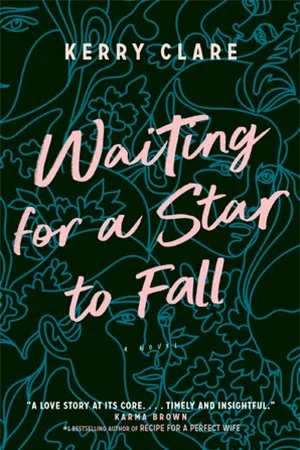
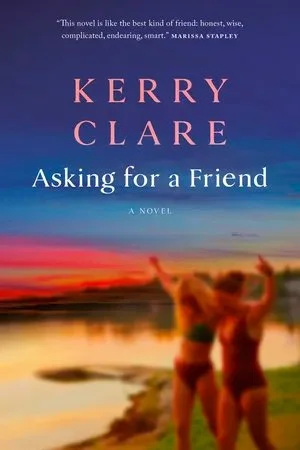
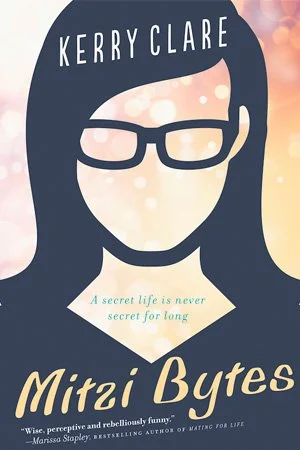
KERRY CLARE is the author of Asking for a Friend, Waiting for a Star to Fall, and Mitzi Bytes. Definitely Thriving is her fourth novel. A National Magazine Award-nominated essayist and editor of The M Word: Conversations About Motherhood, Kerry also edits the Canadian books website 49thShelf.com, is host of the BOOKSPO podcast, and writes about books and reading at her longtime blog, Pickle Me This. She lives in Toronto with her family.